A New Day

It’s New Year’s Day,

For once nature is noisier than the neighbours.

Cars still cross and tarmac creaks,

Under the weight

Of too many After-Eights.


Birds continue tweeting and feeding,

Unaware of the landmark change.

Their cycle continues,

Much the same.


Expectations, hopes, fears;

Leak out of window panes and door frames,

And fill the bracing air.

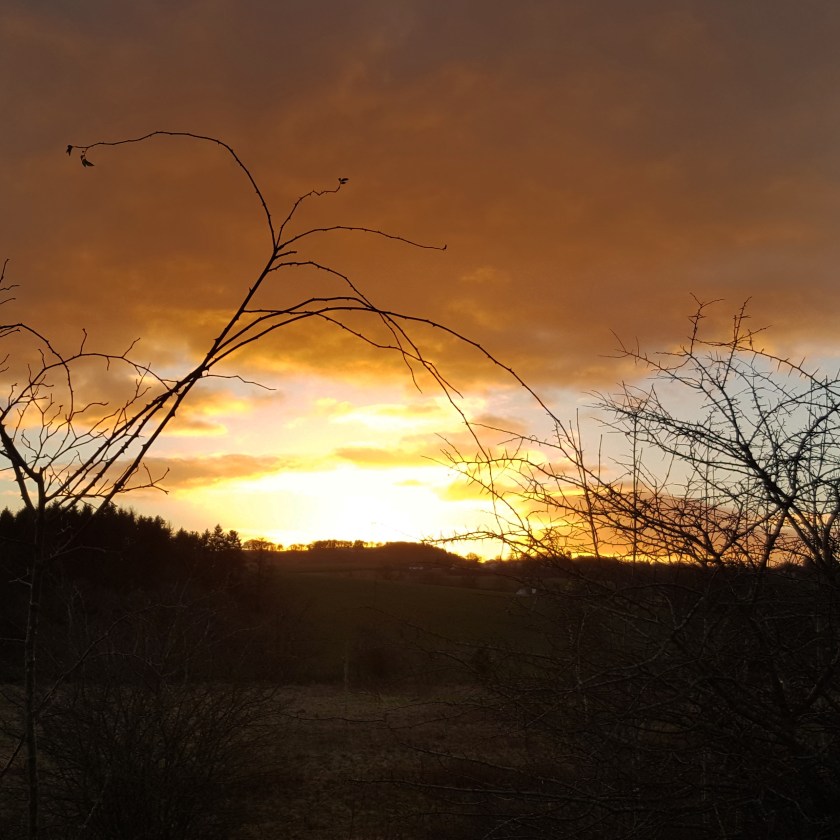
Solar embers ignite the sky,

Sending plumes of white cloud spinning,

Pigment collision.

At the peak of winter, a peek at the warmth soon to reach us.

EMC.

Photo by the author.

The Falling


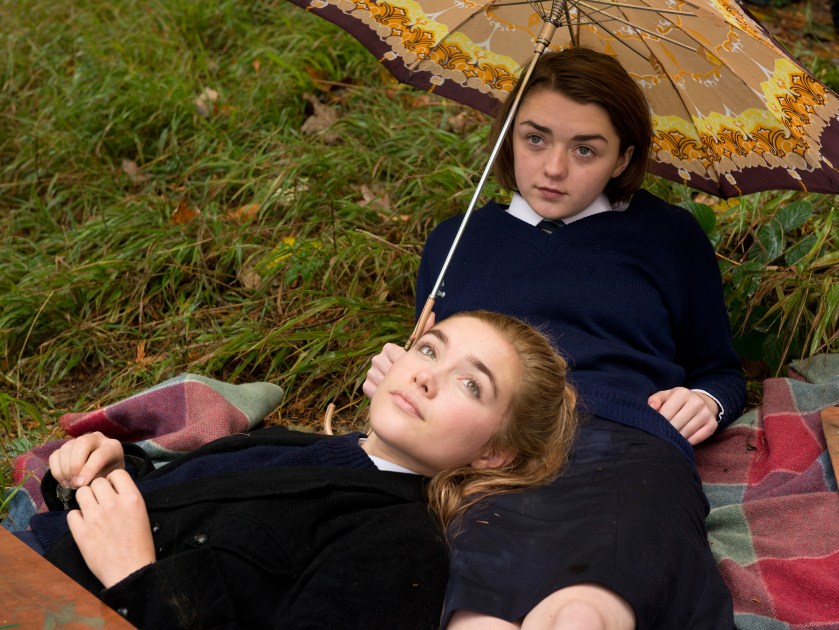
Director Carol Morley Cast  Maisie Williams, Florence Pugh, Maxine Peake
UK, 2014, 1hr 32 mins, 15

The Falling’s writer and director Carol Morley brings her first full length feature film to screen, marking the culmination of a career making predominantly documentaries, by producing this hazy meditation on emerging adulthood.

In tone and feel The Falling is reminiscent of the Australian Picnic at Hanging Rock (Weir, 1975), which sees a boarding school group of girls on a trip inexplicably disappear. Morley has alluded to Antipodean influences, additionally citing the work of Jane Campion and her first feature film Sweetie (1989). This explored the relationships between sisters, in particular an increasingly tension filled dynamic, reflected in the friendships of Morley’s leading cast, alongside a hint of mysticism in the air. The immersion in the world of a girl group facing the disruption of adolescence also finds a point of recognition in The Virgin Suicides (Coppola, 1999). Alongside Campion, Morley’s dual writer/director roles and visual approach place her alongside UK peers such as Andrea Arnold and Lynne Ramsay.

Graduating from the Central Saint Martins College of Art & Design, Morley has amassed a significant collection of short films, touching upon ideas which find themselves surfacing again here, such as in The Alcohol Years (2000), where Morley revisited her younger years to piece together a five year period between the ages of 16 – 21 which were lost. It is in The Madness of the Dance (2006) however, that the clearest connections emerge.

The Madness of the Dance examines a combination of mass hysteria and individual compulsions such as biting and trichotillomania, so called “psychic rebellions.”[1] A Professor (Maxine Peake) takes the viewer on a journey through hysteria in varying forms across the centuries. It was “the ancient Mediterranean world (that) traditionally believed that bodily symptoms we now call hysterical were caused by a womb which wandered throughout the body.” [2] The Hippocratic era notion of the “wandering womb” finds itself under consideration in The Falling, where this collection of hysteric behaviours finds itself transposed and focused in one arena; an all girl’s school in 1969.

The central pairing of The Falling comprises Abigail (Florence Pugh) and Lydia (Maisie Williams). The intensity of their friendship, exhibited through the carving of their initials into a tree together, lingers in a suggestively romantic area. In the way that girls play with each other’s hair, and share their darkest secrets, there is an intensive intimacy entwined with the friendship. This close bond is disrupted in the light of Abigail’s sexual experiences with boys. In the study of mass hysteria there is often the identity of a natural leader, someone particularly charismatic. It finds here two leaders of the charge, in both Abigail and Lydia.

The film opens with a shot of the water, the lake in the school grounds, reflecting the leaves of several looming trees. Their colours are transforming into those of autumn, setting an expectation of an environment on the precipice of change. The film’s themes are also clearly established, as the water soon gives way to the moon, which leads into a science class on the subject of the egg. Womanhood and adolescence are bound up with nature from the initial opening scenes, providing a context of burgeoning sexuality within which the plot of mass hysteria unfolds.

The film employs techniques such as the use of visual layering and a nippy cutting style. The latter is mostly factored into the episodes of hysteria which manifest themselves through fainting spells. The effect is jarring, and disorientating, creating a temporal discontinuity. The technique is used lightly, but effectively plays on notions of perception, which are also wound throughout the film. The dreaminess lends itself to the quality of a nightmare, as what is real and what is not become difficult to discern.

These edited montages could be a collection of skewed memories, recent or long past. This kernel of a reference to collective memories neatly aligns with Morley’s method for her process of creating the film. In a recent interview she explained how she “…thought about what age the characters would be now or which of them would be dead. And what they would say about the events in the film now…”[3] The often hypnotic transitions between scenes, the layering of flowers to faces to bark to tree, offer a presentation of the fragmentary manner in which the mind can piece thoughts together.

The mood of the film is further buoyed by a score which comes from musician Tracey Thorn. The schoolgirls are part of an Alternative Music Orchestra, led by Abigail, whose compositions gave inspiration to Thorn’s score. School instrument favourites – the recorder, the triangle, the xylophone – combine underneath the drip drop knock on wood of a marimba sound. Through this, a hint is given at the cumulative effect of one fall after another to come.

While the school children insist their affliction is real, the majority of the teaching body beg to differ. This results in a conclusion of psychological cause, rather than physical ailment. An out of shot psychiatrist cross-examines the group, the most discernible nod to Morley’s documentary roots emerging in the interview style which is utilised. While the film broadly alludes to repressed issues finding expression in the hysteria outbreak, the message speaks beyond this. These are girls who are kept contained, regimented, and moderated by the school system and the expectations placed upon them. As these restrictions tighten the underlying discontent flows, and bubbles over. These girls have something to say, and they will be heard.  

Originally written for and published on glasgowfilm.org

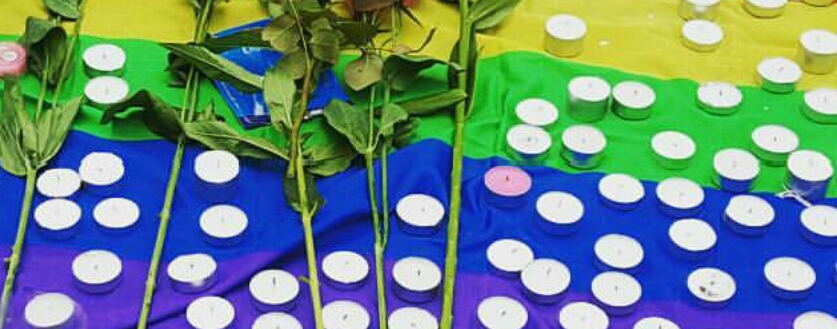
For Orlando

It is said that sexuality doesn’t define,

And no, don’t write me off.

But it is written through me,

Entwined on each fibrous level.

Meshed, hooked and looped from eye to toe.

It even began to taste sweet.

So it shatters my heart,

Rips the tissues apart,

When infiltrated by those who have hated.


Occupying secret spaces,

We have shared language and masked our faces.

Rites of passage thought wrong,

Wandering the straight and narrow for too long.

Until, you dare to deviate otherwise.

Hands contorted from decades of doors prised,

open.


I am tired, but they can’t wake up.

From the playground taunts to the political haunts,

Every word led to here.

EMC

Originally exhibited as part of the Stonewall Season, November 2016.

Photo by the author.

Thresholds

Unknown to myself,

Hidden in my heart,

Like a hunch in your gut,

Or a voice in the dark.


Strange street signs and alleyways,

can’t see where this leads,

One step at a time,

I trip over my feet.


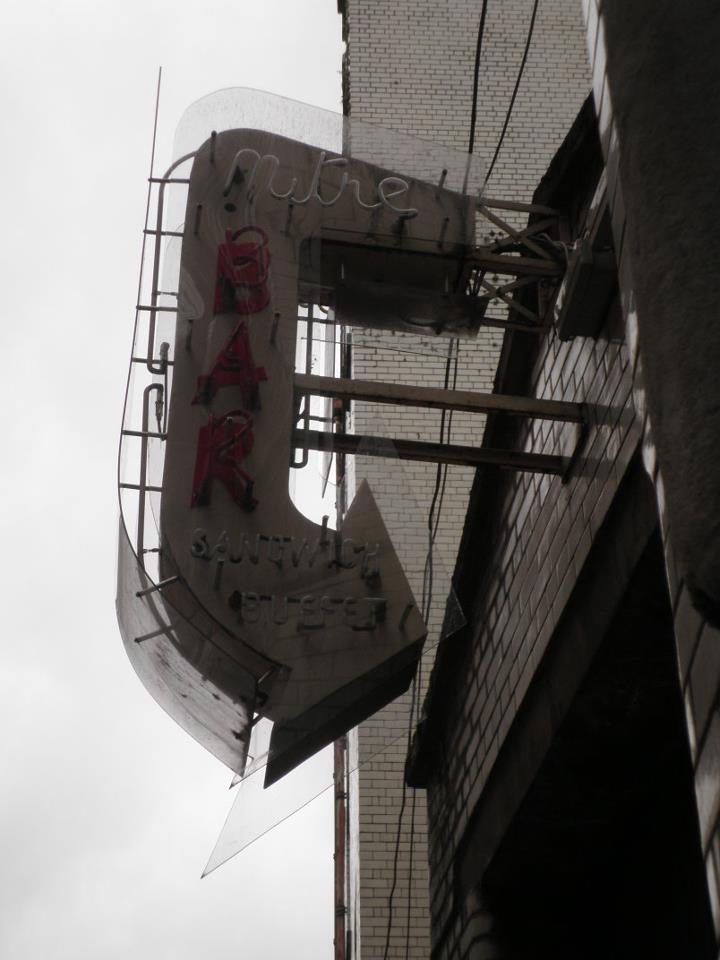
Neon letters glow

With an electric pulse,

A beacon flickers below,

And tells me where


To head first.

No hand to hold,

Go it alone.

Bodies move on impulse, and slip by close.


These are the bright lights,

They thrum and surge,

And I retreat behind them,

into the club.


EMC

Originally exhibited as part of the Stonewall Season, November 2016. 

Photo by the author.


All I Want…

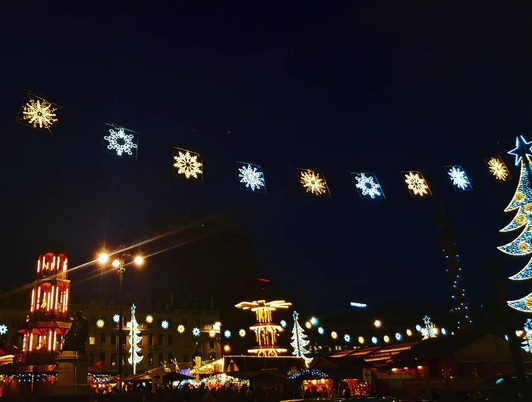
All I want for Christmas

Is to sleep till noon

Scoff chocolate, schlep about,

Blanket fort and pillow spoon.


All I want for Christmas

Is to shut the holly-wreathed door,

The blinds, and the curtains,

And dance around the tinsel strewn floor.


Grapes of a peaceful kind,

Spiced, mulled wine.

Bank balance zero,

Gift giving hero.


All I want for Christmas

Is to be around my folks and friends,

Made a lot easier when,

Their love translates to presence;

Presence, present… priceless.


Whether it’s spiritual or seasonal, winter or yule,

Don’t let those connections slide,

Baby it’s cold outside, keep it warm on the inside.

EMC

Photo by the author.

White God

White God
Director Kornél Mundruczó Cast Zsófia Psotta, Sándor Zsótér, Body and Luke Hungary/Germany/Sweden, 2014, 1h57m, 15.

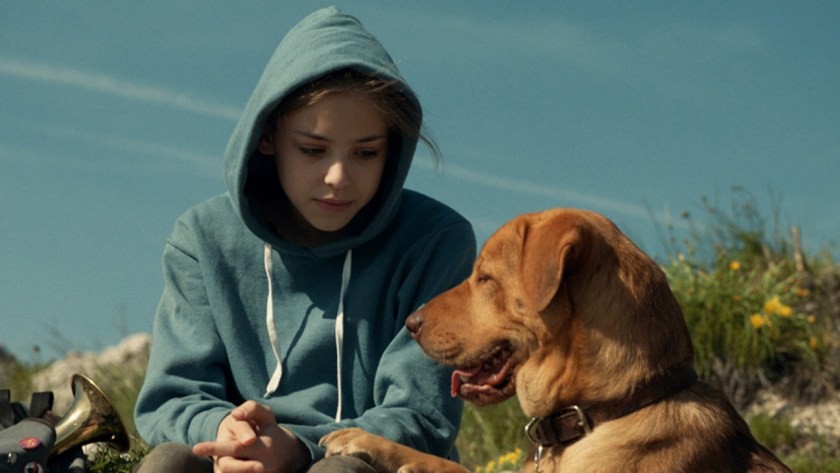
Writer and director Kornél Mundruczó has observed an imbalance of power and a political shift in his home nation of Hungary, and seized upon it to frame the subject of his latest feature, White God.  Ostensibly a story of a pet dog, Hagen, cut loose from his owner Lili (Zsófia Psotta) and embarking on a journey back to her, the socio-political allegory within bares its teeth in equal measure. Winning the Un Certain Regard prize at Cannes in 2014, White God captures a pervasive mood of discontent.

It is ten years since his previous film to feature in the same category at Cannes screened (Johanna, 2005). In the meantime, diverse material has inspired him, including a foray into retelling Shelley’s Frankenstein. Here, however, a more pressing motivation caught him. While visiting an animal shelter, Mundruczó felt moved by the opposition at work, as he occupied the free side of the fence, while the dogs were captured on the other side. His part in ‘the system’ became starkly apparent. He describes this experience further, saying “I’m also the white god that makes the decisions to help them, and I felt really ashamed. And I decided to create a movie out of it.”1

The relationship between Lili and Hagen is one of devotion, trust and heart. Lili is left with her abattoir employed Dad, while her Mum goes to work overseas. Hagen is not welcome in his new home, and finds himself banished to the bathroom for the night. Lili disobeys her father to sleep in the bath to comfort her beloved pet, serenading him with a novel lullaby as she plays the trumpet. Their relationship, separation and his consequent attempt to return evokes fellow waggy tales such as Lassie and Homeward Bound: The Incredible Journey.

The theorist Claude Lévi-Strauss suggested that “animals are good to think”; bonne a penser.  2 In this context the statement can be taken to mean that they are good to think through. Long a symbol for groups of people, animals have the capacity to reflect not just our similarities, but also our differences. Within their own structures and hierarchies they provide a vehicle through which to examine our own behaviours. It is in this way that Hagen and his pack come to represent the underrepresented. Cross-breed Hagen (portrayed by Labrador/Shepherd/Shar Pei mixes Body and Luke) is the subject of a mixed breed (or ‘mutt’) tax. Such a tax was proposed in Hungary in reality, whereby pure bred Hungarian dogs would invite no fee, and thereafter, depending on the mix, varying charges would apply. Allusions to the issues of race, immigration, and scape-goats assigned by arbitrary criteria, are pertinent.

While investigating human social structures and the balance of power, Mundruczó also raises questions of the human treatment of animals. “The consequence of most human-animal encounters is the expression of harm via the pathways of power,” Malamud asserts.3 Such a statement is visually supported by opening scenes set in the abattoir, coolly documenting the processing of carcasses that will later be consumed. He continues, “If we try to think about these animals outside the proscribed, subservient two-dimensional role to which they are

almost always relegated in our culture, we may arrive at some interesting and insightful realisation about ourselves and about how much we do not know about animals.”4 The director attempts to offer such an additional dimension by investing the dogs with agency. He does this by sharing the animal’s perspective, increasingly returning the camera to a Hagen level point of view and directly placing the viewer in his position. Such orientation is utilised at the highest moments of tension – when he is first cut loose from his owner, captured by a stranger, or released into a dog fighting ring – when the animal is most vulnerable. Identification is therefore conferred when it is best employed.

Running on parallel tracks, Lili and Hagen’s narratives go off the rails into their respective difficulties. While Lili navigates adolescence without her faithful companion, Hagen is submitted to a harmful dog-fight training regime. Subject to such brutalisation, feral behaviour begins to brew. The sharp impacts of his mistreatment at the hands of humans, and his new reliance on wild instincts to survive, brings to mind the journeys charted in Jack London’s The Call of the Wild, and White Fang. Even Black Beauty offers reference points, such are the number of hands through which the animal has passed. It is at this turning point that the film realigns itself, blurring genre boundaries. The naturalistic realism of the early scenes gives way to an altogether darker, horror infused tone. As Hagen’s wild instincts are reawakened, the film appears to descend into a dystopian nightmare. The dogs have more than one bone to pick with their oppressors.

Despite their divergent paths, one element of the filmmaking unites both Hagen and Lili in their now separate worlds. Classical music bridges their distance, from Lili continuing with her orchestra practice, to a Tom and Jerry concerto skit on the television which Hagen eyes with interest. In this way, despite the shift in tone and look to the film, a link between the two is maintained. While there are multiple metaphors at play, the music appears to represent a common language, or common humanity. Such a symbol goes on to perform a crucial role in the film, and imparts a greater message about focusing on what we share, rather than what we don’t. A timely modern parable, drawing on the best aspects of its predecessors, White God imploringly asks for understanding, acceptance and unity across differences.

Originally published on glasowfilm.org  Feb 2105

[1]http://www.slate.com/blogs/browbeat/2015/01/30/white_god_director_korn_l_mundrucz_on_the_movie_s_animal_rights_message.html

[2] Claude Lévi-Strauss, Le Totemisme Aujourd’hui (1962)

[3] Randy Malamud, An Introduction to Animals and Visual Culture p. 71 (2012)

[4] Randy Malamud, An Introduction to Animals and Visual Culture,  p. 24 (2012)
Pencilled In

My submission to the University of Aberdeen’s Book Week Scotland Flash Fiction competition.

———

The blankness was intimidating. White vastness like untouched snow. Not a mark, an indentation, or a print. Except for her. This was square one. Of how many squares there might be she didn’t know. She hadn’t seen any others.

She looked at the shadows and lights of her arms and used them as a guide. A drawing from life, still. Finger outstretched, she daubed graphite liberally in front of her. Softly edging out fine lines in a pattern, cross-hatching. This would create the wall. The scale of it made her nervous, but false confidence took hold. It was better than none.

She began to push the lead into the paper with increasing force. When removed to create highlights it would leave a starker contrast. The background had to be not just dark, but like the midnight hours. As if you had your eyes closed with your hand on top too. Her arm was moving quicker and quicker against the resistance of the paper, when it moved. Jolted right in front of her. She froze immediately.

Deliberately slowing down she resumed with conscious care. A crease in the newly drawn wall was throwing the evenness of her lines off. With some more shading in exactly the correct place perhaps she could trick the eyes. Peering very closely, finger all that was separating her nose from patterns in rows, she pushed. It was one push too far, the weakened structure broke, a rip taking a trajectory of its own accord, rapidly splitting all the way down to the ground. Through the space, a solitary eye blinked directly into hers. “I think I’m your neighbour. I drew the square next door?” Like lifting up a bedraggled, loose piece of wallpaper she pulled the paper away and saw a stick drawing in their own line drawn home. Their uncomplicated circle face with oval eyes containing another circle each, and dots for the pupils, nodded her in. She stepped through the paper, careful not to smudge any of herself on either of their designs.

They showed her round, pointing out the garden, sharing ideas, and patterns. They were taken aback at her own appearance. She had worked on herself before her surroundings, creating more depth and detail, practising. Then she had turned outwards, drawing whatever felt right and true. “I’m more words than drawings,” they said. Smiling sympathetically to themselves. They handed her a book. “I wrote that. All from my own imagination.” She gladly took it. She had never seen a book before, and didn’t know what it would contain or if she could make sense of it. Slipping back through the tear in the wall, both agreed to keep it there until she had made her own door and outside, to see if she could get round that way. Until then, she would leave a small gap in the paper rip.

She rocked herself in her newly drawn chair. Ankles rotating in gentle motion, she set out to discover her book.

The story was inspired by the image above, ‘Wood cut ‘October’ by Eric Ravilious from Almanack 1929 Watt 686 209 Lan a